National Transport Worker Wages
Rail & bus pay — current classifications, rates, penalties & allowances
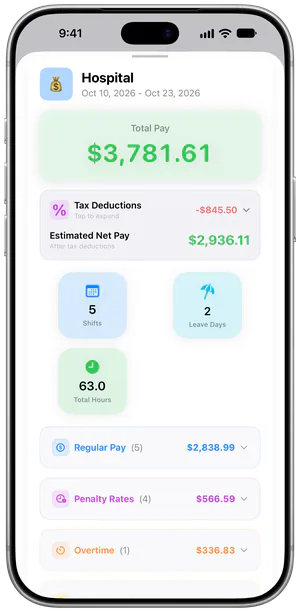

 MyRoster · roster & pay calculator
See what your shifts pay at these rates
Add your roster and MyRoster works out your take-home pay from the rates on this page, with penalties, allowances, overtime, tax and super included.


On a computer? Scan with your phone's camera to get MyRoster.
Roles & Wages
| Role | Pay Point | July 2025 | July 2026 |
|---|---|---|---|
Clerical, Administration and Professional (CAP) Rail Worker Minimum weekly base rate for the Clerical, Administration and Professional stream. Employees engaged on an annual salary equivalent at or above Level 7 are not entitled to overtime (cl 20.2). | Level 1 | $25.53 $50,617.32 / yr | $26.75 $53,022.2 / yr |
| Level 2 | $27.58 $54,670.67 / yr | $28.89 $57,268.57 / yr | |
| Level 3 | $28.64 $56,767.77 / yr | $30.00 $59,464.78 / yr | |
| Level 4 | $29.91 $59,282.2 / yr | $31.33 $62,099.2 / yr | |
| Level 5 | $32.45 $64,331.93 / yr | $33.99 $67,388.9 / yr | |
| Level 6 | $34.78 $68,953.9 / yr | $36.44 $72,229.97 / yr | |
| Level 7 | $36.90 $73,153.32 / yr | $38.66 $76,627.62 / yr | |
| Level 8 | $41.56 $82,392.03 / yr | $43.54 $86,304.53 / yr | |
| Level 9 | $49.82 $98,767.15 / yr | $52.19 $103,456.93 / yr | |
Operations (Op) Rail Worker Minimum weekly base rate for the Operations stream. Level 1 is the entry-level classification — its 1 July 2026 rate reflects the Annual Wage Review $978.10 per week entry-level floor. | Level 1 | $24.28 $48,134.18 / yr | $25.74 $51,024.22 / yr |
| Level 2 | $25.74 $51,029.43 / yr | $26.97 $53,455.18 / yr | |
| Level 3 | $28.43 $56,355.65 / yr | $29.78 $59,031.8 / yr | |
| Level 4 | $31.19 $61,822.72 / yr | $32.67 $64,759.7 / yr | |
| Level 5 | $34.15 $67,696.68 / yr | $35.77 $70,910.15 / yr | |
| Level 6 | $36.50 $72,360.38 / yr | $38.24 $75,798.17 / yr | |
Technical and Civil Infrastructure (TCI) Rail Worker Minimum weekly base rate for the Technical and Civil Infrastructure stream. TCI employees are also eligible for the clause 18.3 disability allowances (wet places, confined spaces, dirty work, height money and similar). The Level 1 rate from 1 July 2026 reflects the Annual Wage Review $1,004.90 per week floor for the lowest ongoing classification. | Level 1 | $24.95 $49,454 / yr | $26.44 $52,422.28 / yr |
| Level 2 | $25.85 $51,243.32 / yr | $27.08 $53,679.5 / yr | |
| Level 3 | $26.70 $52,928.3 / yr | $27.97 $55,442.73 / yr | |
| Level 4 | $28.12 $55,734.87 / yr | $29.45 $58,379.72 / yr | |
| Level 5 | $29.37 $58,212.78 / yr | $30.76 $60,977.62 / yr | |
| Level 6 | $30.67 $60,800.25 / yr | $32.13 $63,690.28 / yr | |
| Level 7 | $33.09 $65,599.58 / yr | $34.66 $68,713.93 / yr |
Allowances
| Allowance | Unit | July 2025 | July 2026 |
|---|---|---|---|
First aid allowance (cl 18.2(a)) Employee trained in first aid, holding current qualifications, and appointed by the employer as a first aid officer. | Per week | $20.30 | $21.26 |
On-call allowance — per night (cl 18.2(b)(i)) Employee required by the employer to be on-call during a period off duty. The 2026 Pay Guide notes this allowance does not apply to Clerical, Administration and Professional classifications at or above Level 7. | Per night | $13.89 | $14.55 |
On-call allowance — per day and night (cl 18.2(b)(i)) On-call across a full day and night. Same eligibility as the per-night rate. | Per day and night | $34.84 | $36.49 |
Wet places allowance (cl 18.3(d)(i)) Technical and civil infrastructure employees working in any place where their clothing or boots become saturated by water, oil or another substance. | Per hour | $0.82 | $0.85 |
Confined spaces allowance (cl 18.3(e)) Technical and civil infrastructure employees working in a confined space. | Per hour | $1.07 | $1.12 |
Dirty work allowance (cl 18.3(f)) Technical and civil infrastructure employees performing work of an unusually dirty or offensive nature, as agreed with the supervisor. | Per hour | $0.82 | $0.85 |
Height money (cl 18.3(g)) Technical and civil infrastructure employees (other than linespersons/riggers) engaged in construction, erection, repair or maintenance of structures at a height of 15 metres or more. | Per hour | $0.59 | $0.62 |
Insulation materials allowance (cl 18.3(h)) Technical and civil infrastructure employees handling loose slag wool, loose insulwool or other similar loose insulation materials. | Per hour | $1.07 | $1.12 |
Explosive powered tools allowance — hourly (cl 18.3(i)) Technical and civil infrastructure employees required to use explosive powered tools. Capped at the daily maximum shown below. | Per hour | $0.28 | $0.29 |
Explosive powered tools allowance — daily maximum (cl 18.3(i)) Maximum payable per day for the explosive powered tools allowance. | Per day | $2.11 | $2.21 |
Foundry allowance (cl 18.3(j)(i)) Technical and civil infrastructure employees, for each hour worked in a foundry, to compensate for disagreeable features. | Per hour | $0.62 | $0.65 |
Early morning or afternoon shift allowance (cl 21.2(a)) Flat amount added to the ordinary hourly rate (13.24% of the standard rate) for a shift commencing at or after 4am and before 5.30am (early morning) or at or after 12pm and before 6pm (afternoon). | Per hour | $3.72 | $3.90 |
Night shift allowance (cl 21.2(b)) Flat amount added to the ordinary hourly rate (15.73% of the standard rate) for a shift commencing at or after 6pm and before 4am. | Per hour | $4.42 | $4.63 |
Permanent night shift allowance (cl 21.2(c)) Flat amount added to the ordinary hourly rate (29.86% of the standard rate) for an employee who works night shift only for more than 4 weeks. | Per hour | $8.40 | $8.79 |
Tool allowance (cl 18.4(b)(i)) Tradesperson required to provide and maintain the tools ordinarily required by that trade; paid for all purposes. Published as a weekly rate until 30 June 2026 and as an hourly rate from 1 July 2026. | Per week / Per hour | $20.86 per week | $0.55 per hour |
Meal allowance (cl 18.4(c)) Paid to an employee who works more than 2 hours of overtime in a minimum of 10 hours on duty. | Per occasion | $21.17 | $22.04 |
Penalty Rates
Full-time and part-time employees. Overtime is work beyond 8 hours per day or 38 hours per week; employees on an annual salary equivalent at or above CAP Level 7 are not entitled to overtime.
Full-time and part-time employees. A 10-hour rest period applies after overtime.
Full-time and part-time employees — ordinary hours and overtime.
Full-time and part-time employees — ordinary hours and overtime.
Full-time and part-time employees — ordinary hours and overtime.
Casual base rate: the minimum hourly rate plus 25% casual loading.
Casual employees.
Casual employees.
Casual employees — ordinary hours and overtime.
Casual employees — ordinary hours and overtime.
Casual employees — ordinary hours and overtime.
Loading on annual leave for non-shiftworkers.
Loading on annual leave for shiftworkers, who receive 5 weeks of annual leave.
Notes
- •These figures are the minimum weekly pay rates for full-time adult employees in Australian dollars under the Rail Industry Award 2020, the national modern award safety net for the rail industry. Many rail employees are covered by enterprise agreements that pay above these minimums.
- •Rates apply from the first full pay period starting on or after 1 July each year. The 1 July 2026 rates reflect the Annual Wage Review 2025-26 decision: a 4.75% increase to modern award minimum rates, with floors of $1,004.90 per week for the lowest ongoing classification and $978.10 per week for the lowest entry-level classification applied where a flat 4.75% would fall short.
- •Ordinary full-time hours are 38 per week. Work beyond 8 hours per day or 38 hours per week is overtime; employees engaged on an annual salary equivalent at or above Clerical, Administration and Professional Level 7 are not entitled to overtime.
- •Hourly rates are the weekly rate divided by 38. Casual employees receive the hourly rate plus a 25% loading (shown under Penalties).
- •Junior employees are paid a percentage of the applicable adult weekly rate: 75% under 17 years, 85% at 17 years and 100% at 18 years. Apprentice and adult apprentice rates are set as percentages of adult rates under clause 15.3 (varying by apprenticeship year, start date and Year 12 completion) and are not shown here.
- •Shift allowances are flat per-hour dollar amounts added to the ordinary hourly rate, fixed at 13.24% (early morning/afternoon), 15.73% (night) and 29.86% (permanent night) of the award standard rate.
- •The tool allowance was published as $20.86 per week up to 30 June 2026; from 1 July 2026 the Pay Guide publishes it as $0.55 per hour.
- •Source: Rail Industry Award 2020 (MA000015), Fair Work Commission — rates from the Fair Work Ombudsman Pay Guide, published 24 June 2026.
Calculate Your Pay
Download MyRoster to automatically calculate your wages with all penalties and allowances included.
On a computer? Scan with your phone's camera to get MyRoster.
Transport wages in other states
Compare transport worker pay rates, penalties and allowances across every Australian state and territory.